Basement & Sump
Sump Pump Battery Backup: Why Every Algonquin Basement Needs One
The failure mode is almost comically predictable: the pit fills fastest at the exact moment the power goes out. A backup is how you stop being surprised by it.
Here is the scenario, and it plays out every spring in Algonquin, Lake in the Hills and Crystal Lake.
A line of storms comes through in the evening. Two inches of rain in three hours on ground that is already saturated. The sump pit, which has been running steadily for two days, starts cycling every ninety seconds.
Then the power flickers and goes out.
The pump stops. The pit keeps filling. Nobody notices until someone goes downstairs.
Why it is the same storm every time
This is not coincidence and it is worth understanding, because it explains why a backup is not optional.
The weather system that produces enough rain to overwhelm your drain tile is the same system with the wind and lightning that takes down power lines. The two events are correlated, not independent.
So the standard homeowner assumption — 'my pump works fine, and outages are rare' — misses the point. The outage is most likely to happen exactly when the pump matters most. A pump with no backup is protected against every scenario except the one that actually occurs.
How a battery backup system works
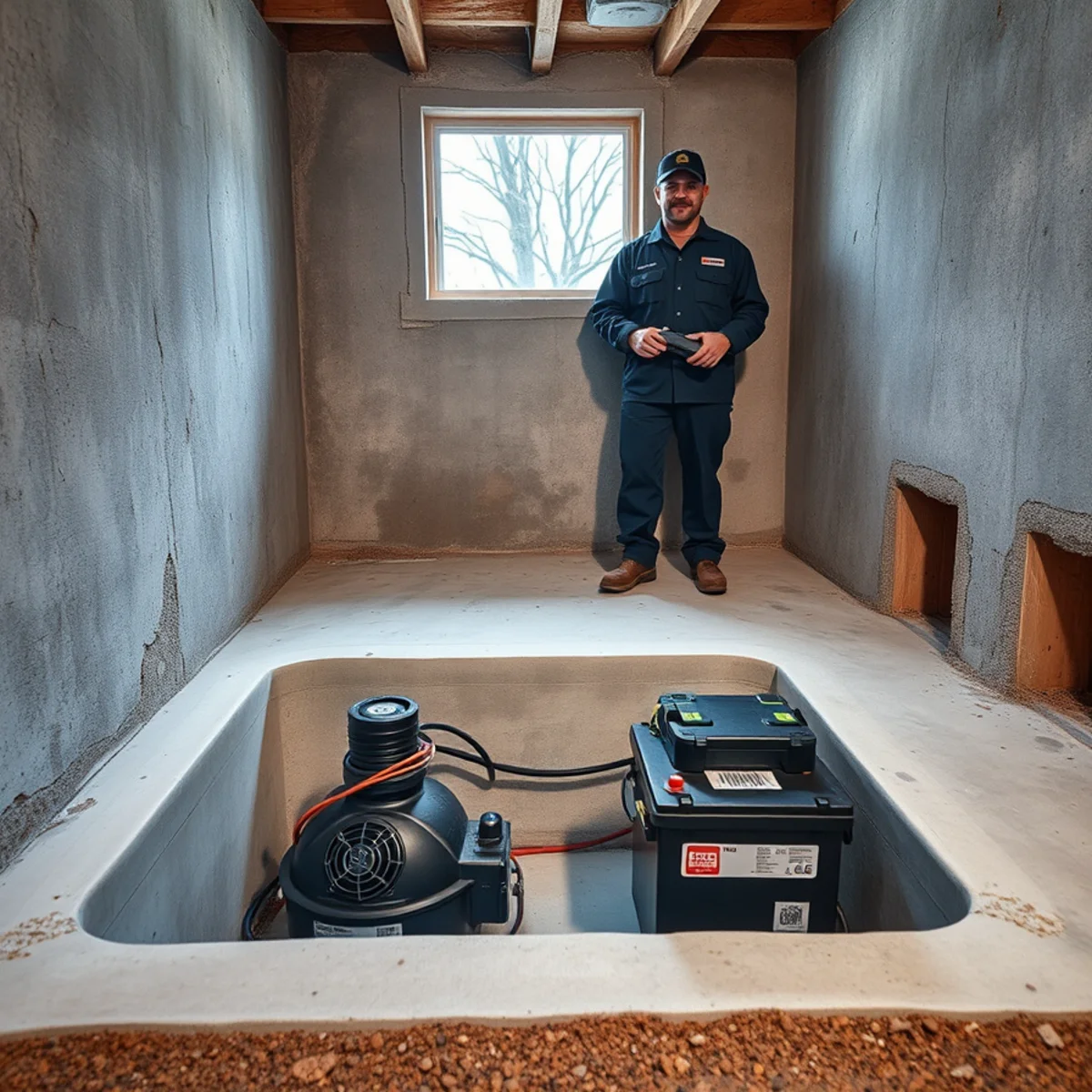
A proper backup is a second, independent pump sitting in the same pit at a slightly higher elevation than the primary, connected to its own discharge or a shared line with a second check valve.
It runs off a deep-cycle battery kept charged by a controller plugged into household power. When the primary cannot keep up — or has no power to run on — the water rises to the backup's float and the backup takes over.
Good systems include an alarm, and the better ones include WiFi monitoring that texts you when the backup activates. That alert is worth as much as the pump, because it tells you something is wrong while you can still do something about it.
How long will it actually run?
This is where honest numbers matter, because the marketing numbers are optimistic.
Runtime depends on how hard the pump has to work: how much water is arriving, and how high it has to lift it. A backup pumping intermittently in a slow pit can run a very long time. The same battery in a pit filling continuously during a heavy storm gives you far less.
A realistic planning figure for a deep-cycle battery in a hard-working pit is several hours of heavy intermittent duty, and considerably longer under light load. If your pit fills fast, a second battery in parallel roughly doubles that.
We size the battery against your pit's measured inflow rather than quoting a catalog number, because a runtime figure that does not account for your actual inflow is not a figure at all.
Battery backup versus water-powered backup
Water-powered backups use municipal water pressure to create suction that moves sump water. They need no battery, no charging and no maintenance, and they will run as long as the water supply holds.
The trade-offs are real. They consume municipal water — often a meaningful volume per gallon pumped — they only work if you are on municipal supply (not a well), they need a backflow preventer, and some jurisdictions restrict them.
For most Algonquin homes, battery backup is the right answer. Where a homeowner travels frequently and cannot maintain a battery, a water-powered unit deserves a look. We will tell you which fits your situation rather than defaulting to one.
When one backup is not enough
In some homes the failure mode is not power — it is volume. The primary pump is running continuously and simply cannot move water as fast as it arrives.
That is common on the slopes down toward the Fox River in Algonquin, and it is the norm on riverfront property in Port Barrington, where groundwater rises directly with the river.
For those homes, the right answer is often two primary pumps on separate circuits plus a battery backup — a system that handles both failure modes rather than only one.
Maintenance a backup actually needs
- Test the backup twice a year by unplugging the primary and confirming the backup takes over. A backup nobody has tested is not a backup.
- Check battery terminals for corrosion and confirm the charger indicator shows a healthy charge. Standard flooded batteries need the electrolyte level checked; sealed AGM batteries do not.
- Plan on replacing the battery every three to five years. It will fail quietly, which is why the replacement is on a schedule rather than on symptoms.
- Confirm both pumps' floats swing freely and are not fouled by the orange sludge of iron bacteria, which is common in McHenry County groundwater.
- Verify the discharge line is clear and, in winter, that the outlet is not iced over. A pump running against a frozen discharge burns out.
What it costs versus what it prevents
A battery backup system is a modest fraction of what water damage restoration on a finished basement costs — and that is before you count the drywall, the flooring, the furniture and the things that were in boxes on the floor.
If your basement is unfinished storage space with a floor drain, the calculation is genuinely debatable. If it is finished living space, or it holds anything you would be upset to lose, it is not.
Our sump pump installation and backup page covers sizing, and if you are in Algonquin we are only a few minutes away — which matters in April.
Quick answers
How long does a sump pump battery backup last during an outage?
It depends entirely on inflow. Several hours of heavy intermittent pumping is a realistic planning figure for a single deep-cycle battery, and considerably longer under light load. A second battery in parallel roughly doubles it.
How often should the backup battery be replaced?
Every three to five years. Batteries degrade quietly rather than failing visibly, so replacement should be on a schedule rather than a reaction to symptoms.
Is a water-powered backup better than a battery backup?
It depends. Water-powered units need no battery and run indefinitely, but they consume municipal water, require a backflow preventer, are not an option on a well, and are restricted in some jurisdictions. For most homes here, battery backup is the better fit.
Need a hand with this?
Talk to the plumber who wrote this
We are a licensed, owner-operated shop on Pine Street in Lake in the Hills. Free written estimates on non-emergency work, and a real person answering the phone when it cannot wait.
- 5.0 from 11 Google reviews
- Licensed & insured
- 24/7 emergency service